
Announcements

Bachelor of Business Administration
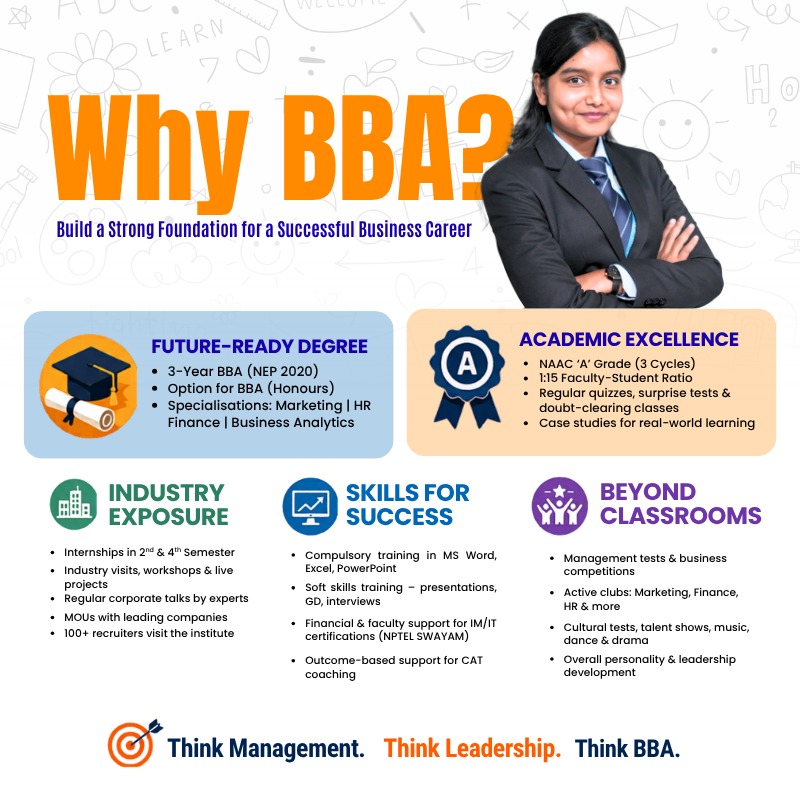
Aligned with NEP 2020, the BBA programme at Srusti is a 3-year full-time degree with an optional 1-year Honours/Research specialisation, designed to develop agile, ethical, and innovative business leaders. Blending academic learning with real-world exposure, the programme emphasises entrepreneurship, innovation, and responsible management practices.
Structured under the Four-Year Undergraduate Programme (FYUGP) model (Four Years | Eight Semesters), the curriculum builds strong foundations in management, communication, analytics, and decision-making. With experienced faculty, industry exposure, practical learning opportunities, and a strong alumni network, students graduate with the skills required for careers in marketing, HR, finance, business analytics, consulting, retail, entrepreneurship, and public sector roles, while also preparing for higher studies such as MBA/PGDM, Masters programmes, and competitive management entrance examinations.
Graduate Outcomes
The BBA (Hons) program at SAGS is designed to develop graduates with a strong blend of academic, professional, and personal capabilities:
- Strong managerial and business acumen with the ability to apply multidisciplinary knowledge in real-world situations.
- Analytical and critical thinking skills to interpret data, evaluate alternatives, and make informed decisions.
- Effective communication and interpersonal skills for professional success in diverse organizational settings.
- Leadership and teamwork capabilities to manage people, collaborate effectively, and drive organizational performance.
- Ethical orientation and social responsibility with sensitivity towards sustainability, governance, and societal well-being.
- Digital and technological competence to adapt to emerging business environments and leverage modern tools.
Learning Outcomes
Management Knowledge Application
Apply fundamental and advanced management concepts across functional areas (marketing, finance, HR, operations) to solve real-world business problems.
Analytical & Critical Thinking Skills
Analyze business data, economic conditions, and organizational situations using logical reasoning and quantitative techniques.
Decision-Making Ability
Demonstrate the ability to evaluate complex business challenges and formulate structured, practical, and innovative solutions.
Communication & Professional Collaboration
Demonstrate effective decision-making by integrating financial, operational, and strategic perspectives.
Communication Competence
Exhibit professional communication skills—written, verbal, digital, and interpersonal—in diverse business environments.
Leadership & Teamwork
Demonstrate leadership qualities and ability to work effectively in teams, managing diversity and organizational dynamics.
Ethical & Social Responsibility
Apply ethical principles, corporate governance, and social responsibility in business decisions and professional conduct
Digital & Technological Proficiency
Utilize modern technologies, MIS tools, and digital platforms for business analysis and operations.
Entrepreneurship & Innovation
Demonstrate entrepreneurial mindset by identifying opportunities, developing business models, and fostering innovation.
Research & Problem-Solving Skills
Conduct research, analyze data, and develop evidence-based solutions to business problems.
Global & Holistic Perspective
Understand global business environment, cultural diversity, and sustainability to operate effectively in international and dynamic contexts.

Beyond Learning to Manage - Learning to Decide, Lead, and Deliver.

Programme Structure
The BBA (Hons) program is structured to progressively build business understanding, analytical ability, and professional competence. The curriculum begins with strong foundations in management, economics, and accounting, while simultaneously developing communication and digital skills.
As students advance, the focus shifts to core business domains such as marketing, finance, and human resources, supported by case-based learning and practical applications. Value-added modules and industry exposure ensure continuous alignment with real-world expectations. The final phase emphasises specialisation, internships, and project-based learning—enabling students to apply knowledge, make decisions, and perform in professional environments.
Programme Architecture
To fulfill the requirements of the Bachelor of Business Administration program, students must complete a total of 120 credits.
Program Architecture For BBA 03 Yrs Program
Core Subjects
Ability Enhancement Courses (AEC)
Multi Disciplinary Elective Courses (MDC)
Value Added Courses (VAC)
Skill Enhancement Courses (SEC)
Discipline Specific Elective (DSE)
Program Architecture For BBA (Hons) 04 Yrs Program
Core Subjects
Ability Enhancement Courses (AEC)
Multi Disciplinary Elective Courses (MDC)
Value Added Courses (VAC)
Skill Enhancement Courses (SEC)
Discipline Specific Elective (DSE)
Program Architecture For BBA (Hons) with Research 04 Yrs Program
Core Subjects
Ability Enhancement Courses (AEC)
Multi Disciplinary Elective Courses (MDC)
Value Added Courses (VAC)
Skill Enhancement Courses (SEC)
Discipline Specific Elective (DSE)
Specializations
Finance
- Apply financial tools and techniques for analysis and decision-making
- Evaluate markets, instruments, and risk-return dynamics
- Develop strategies for investment, taxation, and financial planning
- Use financial modelling and analytics for data-driven insights
Key Learning Areas
- International Financial Management
- Banking and Insurance
- Financial Markets Products and Services
- Investment Analysis & Portfolio Management
- Business Analysis & Valuation
- Financial Planning
- Financial Derivatives
- Strategic Corporate Finance
- Financial Modelling
- Financial Analytics
- Direct Taxation
- Sustainable Finance
- Behavioral Finance (Neuro Finance)
Marketing
- Analyze consumer behavior and market trends to design effective marketing strategies.
- Develop and implement marketing plans using digital, retail, and service marketing approaches.
- Apply branding, communication, and sales management techniques.
- Evaluate marketing performance using analytics and data-driven tools.
Key Learning Areas
- International Financial Management
- Banking and Insurance
- Financial Markets Products and Services
- Investment Analysis & Portfolio Management
- Business Analysis & Valuation
- Financial Planning
- Financial Derivatives
- Strategic Corporate Finance
- Financial Modelling
- Financial Analytics
- Direct Taxation
- Sustainable Finance
- Behavioral Finance (Neuro Finance)
Human Resource Management(HRM)
- Apply HR concepts in recruitment, training, performance management, and compensation systems.
- Analyze organizational behavior and manage workforce diversity, conflict, and change effectively.
- Design HR strategies for employee engagement and talent management.
- Utilize HR analytics and modern HR tools for strategic decision-making.
Key Learning Areas
- HRD – Systems & Strategies
- Change Management and Organizational Development
- Training & Development
- Performance & Compensation Management
- Negotiation Skills
- Cross Culture HRM
- HR Analytics
- Team Building in Organizations
- Behavioral Testing and Training for Employee Retention
- Talent Acquisition and Management
- Compensation Management
- Employee Life Cycle Management
- Coaching & Mentoring
Business Analytics
- Apply data analytics tools (R/Python, visualization) to interpret business data.
- Analyze business problems using statistical and analytical techniques.
- Develop data-driven insights for marketing, finance, and HR decision-making.
- Use predictive and descriptive analytics to improve business performance.
Key Learning Areas
- Data Analytics using R / Python
- Data Visualization
- Marketing Analytics
- Finance Analytics
- HR Analytics
- Social Media & Web Analytics
International Business
- Analyze global business environments and international trade practices.
- Apply cross-cultural and international marketing strategies.
- Evaluate international financial, legal, and operational frameworks.
- Develop strategies for global expansion, trade, and cross-border operations.
Key Learning Areas
- International Trade Policy & Strategy
- Global Business Environment
- Transnational & Cross-Cultural Marketing
- International Supply Chain Management
- International Accounting & Reporting System
- International Ventures, Mergers & Acquisitions
- EXIM Policy and Documentation
Supply Chain Management
- Analyze supply chain networks, logistics systems, and operations strategies.
- Apply quantitative models for inventory, quality, and process optimization.
- Develop efficient logistics and distribution strategies for business operations.
- Utilize analytics tools to enhance supply chain performance and decision-making.
Key Learning Areas
- Operations Strategy
- Management Decision Models
- Quality Management and Business Process Improvement
- International Supply Chain Management
- Project Management
- Supply Chain Analytics
- Inventory Management
- Logistics & Distribution Management
Project
This is where learning is tested, applied, and proven. Through structured projects, students engage with real business scenarios, build analytical depth, and demonstrate their ability to translate knowledge into meaningful outcomes.
Capstone Project I
Students undertake self-directed projects aligned with their area of interest, enabling them to build a professional portfolio. These projects develop research orientation, teamwork, and the ability to apply frameworks and business models to real-world challenges.
Capstone Project II
The program culminates in a capstone project where students work on real industry problems. This involves research, analysis, and solution development, followed by a detailed report and presentation—demonstrating their readiness for professional environments.
Dissertation
An independent research study that develops analytical depth, critical thinking, and the ability to generate evidence-based insights.