
Announcements

Bachelor of Computer Application
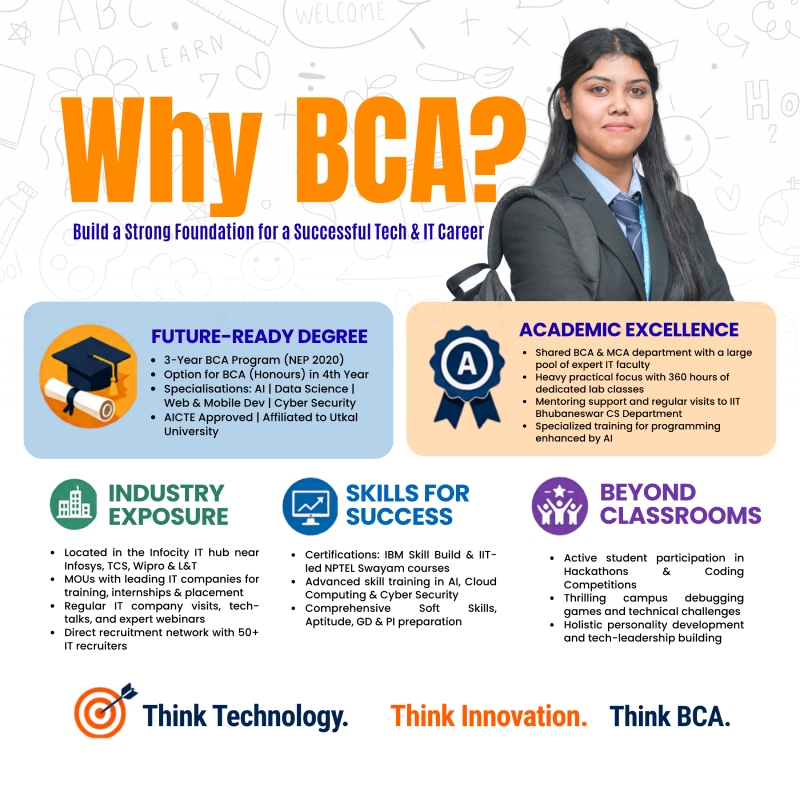
Aligned with NEP 2020, the BCA programme at Srusti is a 3-year full-time degree with an optional 1-year Honours/Research specialisation, designed to develop technically competent, analytical, and industry-ready technology professionals. Blending academic rigour with applied learning, the programme emphasises computational thinking, innovation, ethical digital practices, and multidisciplinary skill development to nurture future-ready professionals capable of solving real-world technological challenges.
Structured under the Four-Year Undergraduate Programme (FYUGP) model (Four Years | Eight Semesters), the curriculum builds strong foundations in programming, software development, databases, operating systems, networking, and emerging digital technologies, while integrating skill enhancement, value-added learning, internships, and industry exposure. Supported by experienced faculty, practical lab-based pedagogy, project-driven learning, and specialised pathways in Artificial Intelligence, Data Science, Web & Mobile Application Development, and Cyber Security, students graduate prepared for careers in software development, data analytics, IT consulting, cybersecurity, system administration, entrepreneurship, and allied technology domains, while also being equipped for higher studies such as MCA, MSc, specialised postgraduate programmes, and competitive examinations in the IT sector.
Graduate Outcomes
The BCA programme is designed to develop graduates who demonstrate the following attributes:
- Technically Competent Professionals: Possess strong foundations in programming, computing, and emerging technologies to solve real-world problems efficiently.
- Analytical & Problem-Solving Thinkers: Demonstrate logical reasoning, computational thinking, and the ability to analyze complex problems and develop innovative solutions.
- Industry-Ready & Skilled Individuals: Equipped with practical skills in software development, data analytics, and modern tools to meet dynamic industry requirements.
- Effective Communicators: Exhibit strong communication skills to present ideas clearly and collaborate effectively in professional environments.
- Ethical & Responsible Digital Citizens: Uphold ethical values, cyber responsibility, and professional integrity in the use of technology.
- Multidisciplinary & Holistic Learners: Integrate knowledge across domains such as management, economics, and social sciences for well-rounded decision-making.
- Innovative & Entrepreneurial Mindset: Demonstrate creativity, innovation, and entrepreneurial skills to develop technology-driven solutions and startups.
- Lifelong Learners & Adaptable Professionals: Continuously upgrade skills and adapt to evolving technologies, ensuring long-term professional growth.
Learning Outcomes
Computational Knowledge
Apply knowledge of computer science, programming, mathematics, and computing fundamentals to solve complex problems.
Problem Analysis
Identify, formulate, and analyze real-world problems using computational thinking and logical reasoning
Design & Development of Solutions
1. Design, develop, and implement software applications and systems that meet specified requirements with consideration for societal and environmental needs.
Modern Tool Usage
Use appropriate modern tools, programming languages, frameworks, and technologies for software development and data analysis.
Individual & Team Work
1. Function effectively as an individual and as a member or leader in multidisciplinary teams.
Ethics
Understand and apply ethical principles, cyber ethics, and professional responsibilities in computing practices
Environment & Sustainability
1. Analyze the impact of computing solutions on society and environment, and promote sustainable and responsible use of technology.
Communication
Communicate effectively with technical and non-technical stakeholders through reports, presentations, and documentation.
Life-long Learning
Recognize the need for continuous learning and adapt to rapidly changing technologies and industry trends
Project Management
1. Apply project management principles, time management, and organizational skills in software development and IT projects.
Innovation & Entrepreneurship
Demonstrate entrepreneurial mindset and innovation skills to develop technology-driven solutions and startups.
Data Handling & Analytical Skills
1. Analyze data using statistical and computational tools to support decision-making and problem-solving.

Shaping Digital Thinkers, Problem Solvers, and Technology Leaders.

Programme Structure
To fulfill the requirements of the Bachelor of Computer Application program, students must complete a total of 126 credits.
Programme Architecture
To fulfill the requirements of the Bachelor of Business Administration program, students must complete a total of 120 credits.
Program Architecture For BCA 03 Yrs Program
Core Subjects
Ability Enhancement Courses (AEC)
Multi Disciplinary Elective Courses (MDC)
Value Added Courses (VAC)
Skill Enhancement Courses (SEC)
Discipline Specific Elective (DSE)
Program Architecture For BCA (Hons) 04 Yrs Program
Core Subjects
Ability Enhancement Courses (AEC)
Multi Disciplinary Elective Courses (MDC)
Value Added Courses (VAC)
Skill Enhancement Courses (SEC)
Discipline Specific Elective (DSE)
Program Architecture For BCA (Hons) with Research 04 Yrs Program
Specializations
Artificial Intelligence (AI)
The Artificial Intelligence specialization equips students with the ability to build intelligent systems that simulate human thinking and decision-making. The programme focuses on machine learning, automation, and real-world AI applications across industries.
Key Learning Areas
- Machine Learning & Deep Learning
- Natural Language Processing (NLP)
- Computer Vision
- AI Algorithms & Applications
- Python for AI
Data Science
The Data Science specialization focuses on extracting meaningful insights from data using statistical, analytical, and computational techniques. It prepares students to work with large datasets and support data-driven decision-making.
Key Learning Areas
- Data Analytics & Visualization
- Statistical Methods
- Big Data Technologies
- Python & R Programming
- Predictive Modeling
Web & Mobile Application Development
This specialization focuses on designing and developing dynamic websites and mobile applications with modern tools and frameworks, enabling students to build user-centric digital solutions.
Key Learning Areas
- Frontend & Backend Development
- Full Stack Development
- Mobile App Development
- UI/UX Design
- Cloud Integration
Cyber Security
The Cyber Security specialization prepares students to protect systems, networks, and data from cyber threats. It focuses on ethical hacking, network security, and digital forensics.
Key Learning Areas
- Network Security
- Ethical Hacking
- Cryptography
- Cyber Laws & Ethics
- Digital Forensics
Project
This is where learning is tested, applied, and proven. Through structured projects, students engage with real business scenarios, build analytical depth, and demonstrate their ability to translate knowledge into meaningful outcomes.
Capstone Project I
Students undertake self-directed projects aligned with their area of interest, enabling them to build a professional portfolio. These projects develop research orientation, teamwork, and the ability to apply frameworks and business models to real-world challenges.
Capstone Project II
The program culminates in a capstone project where students work on real industry problems. This involves research, analysis, and solution development, followed by a detailed report and presentation—demonstrating their readiness for professional environments.
Dissertation
An independent research study that develops analytical depth, critical thinking, and the ability to generate evidence-based insights.